
Introduction
Nurses represent the largest segment of healthcare professionals worldwide. In this capacity, their clinical competence is a critical determinant of patient outcomes, safety, and the overall effectiveness of healthcare systems ( 1 ). Nursing competency has been defined by the National Council of State Boards of Nursing (NCSBN) National Simulation Study as “the ability to observe and gather information, recognize deviations from expected patterns, prioritize data, make sense of data, maintain a professional response demeanor, provide clear communication, execute effective interventions, perform nursing skills correctly, evaluate nursing interventions, and self-reflect for performance improvement within a culture of safety” ( 2 ). Ensuring that newly graduated nurses possess this competence is a central aim and challenge for nursing education, particularly in today's increasingly complex hospital environments ( 3 ).
The American Association of Colleges of Nursing (AACN) emphasizes that nursing education must equip graduates with a basic level of clinical competency to ensure patient care and safety. However, several studies have highlighted the inadequacy of clinical training in undergraduate nursing programs, which often fails to fully prepare novice nurses for real-world clinical settings ( 4 - 6 ).
Insufficient competence contributes to a stressful transition from student to professional roles ( 7 , 8 ). Novice nurses frequently report low self-confidence, limited clinical ability, and insufficient competency during their early professional experiences. These stressors are typically attributed to the mismatch between academic preparation and workplace realities ( 9 , 10 ). Consequently, many novice nurses experience emotional and physical fatigue, anxiety, depression, insecurity, and professional disillusionment, which may lead to reduced resilience, job dissatisfaction, and even attrition from the profession ( 11 - 13 ). To mitigate these outcomes, both academic institutions and clinical employers must adopt structured strategies that support novice nurses during their transition ( 14 ). Notable strategies involve the integration of preceptorships, mentorships, and supportive educational interventions into comprehensive induction and orientation frameworks ( 5 ).
A supportive-educational program, in this context, is defined as a structured in-service training initiative that combines emotional support, practical guidance, and targeted educational content aiming at enhancing professional growth and clinical performance during the early stages of employment. This type of program contrasts with general support approaches by incorporating active teaching and coaching components designed to build specific competencies ( 5 ).
In Iran, a developing country in the Middle East, nursing is not a rewarding profession and faces many challenges regarding its public image ( 15 ), education and management. Despite these challenges, nursing students in Iran are selected from among the top-performing high school graduates through a highly competitive national entrance exam known as Konkur. Nevertheless, even with strong academic backgrounds, novice nurses require the guidance of clinically competent mentors to support, motivate, and help them manage the stress associated with transitioning into professional roles ( 16 ).
Nursing competency is a fundamental requirement for delivering effective care and fulfilling professional responsibilities ( 11 ) and plays an important role in improving nursing care ( 17 ). A high level of competency allows nurses to provide high-quality, safe patient care ( 5 , 18 , 19 ). For novice nurses, structured pre-employment education, supportive work environments, and mentorship are crucial for both personal development and a smoother transition into clinical practice ( 17 ). Educational and supportive interventions at the beginning of employment have been shown to enhance job satisfaction, trust, critical thinking, and stress reduction ( 10 ). However, most existing studies rely on self-reported assessments of competence, highlighting the need for intervention-based research to objectively measure the effects of such programs ( 20 ). Implementing appropriate support strategies can ease the transition from student to professional roles, leading to a positive experience at this stage ( 21 - 23 ). Moreover, the role of a coach or mentor is essential in designing in-service supportive programs ( 24 ). In Iran, clinical education is often criticized for inadequately preparing students for real-world practice ( 25 , 26 ). Hence, a persistent gap exists between theoretical knowledge and clinical practice of new nursing graduates ( 8 , 9 , 27 , 28 ). Nursing students seek teachers who can guide and prepare them for the professional challenges during their transition period. A clinical educator who acts as a role model plays an effective role in training and preparing novice nurses in the clinical setting of Iran ( 16 ). Therefore, this study was designed to examine the effect of two in-service programs—one supportive-educational and one supportive-only—on the clinical competency of novice nurses working in Iranian teaching hospitals.
Method
Study Design and Setting
We conducted a quasi-experimental study with three parallel groups across three teaching hospitals in Mashhad, Iran.
Study sample
The study was carried out with the participation of novice nurses employed under the Tarh program in three teaching hospitals. Each hospital was randomly assigned to one of the study groups (supportive-educational, supportive-only, and control). The allocation of individual nurses to each group was determined solely by their hospital assignment. Participation was voluntary, and written informed consent was obtained after explaining the study objectives during on-site meetings with nurses and their head nurses.
The sample size was calculated using PASS software, based on the competency variable, with a 5% Type I error, 90% study power, and a standard deviation of 24. The sample size was estimated to detect a 20-unit difference in the intervention groups, with 32 participants per group, resulting in a total of 96 participants. The necessary parameters for sample size determination were extracted from a similar study. Considering the potential non-normality of distributions, the Mann-Whitney test was applied for statistical analysis.
A total of 100 novice nurses were initially enrolled in the study, with 35 assigned to the supportive-educational group, 33 to the supportive-only group, and 32 to the control group. Ultimately, 97 participants completed the study, as two nurses from the supportive-educational group and one from the supportive-only group withdrew during the study period.
Inclusion criteria
The inclusion criteria for participants were novice nurses employed under the Tarh human resources program, holding a bachelor’s or master’s degree in nursing, with clinical experience ranging from one week to nine months, and willingness to participate in the study.
Exclusion criteria
Nurses who changed their workplace or resigned during the study were excluded.
Intervention
First Intervention Group (Supportive-Educational Program)
After a formal introduction and coordination with the hospital’s nursing management, the researcher collaborated with the educational supervisor to organize the training sessions. Novice nurses were identified and divided into two groups (n=15 and n=16) based on the ward assignment. Each group received an 8-hour educational training over two consecutive days (four 2-hour sessions), delivered via lectures, group discussions, and Q&A sessions. Sessions were conducted by the principal investigator under the supervision of a faculty advisor, and educational materials (slides) were provided to participants.
The educational content was developed using validated sources and covered topics such as organizational and interpersonal communication skills, the concept and development of professional competency, conflict resolution in team settings, and ethical and professional behavior.
The supportive component included structured mentoring. Eleven head nurses participated in a 3-hour preparatory training session focused on the challenges and needs of novice nurses, Hersey and Blanchard’s Situational Leadership Theory ( 29 ), and effective feedback strategies. Two experienced nursing supervisors were selected as mentors in consultation with the hospital’s nursing management. They received additional preparation and were each assigned to supervise 16 novice nurses. The mentorship program spanned four weeks and included five sessions: three clinical mentorship rounds (approximately five hours total), where mentors guided the nurses through hospital organizational structure, clinical skill checklists, professional ethics, and feedback discussions and two one-on-one consultation sessions (one hour each), focused on self-directed learning strategies, case-based problem solving, and conflict management in the clinical setting.
Second Intervention Group (Supportive-only)
The second intervention was focused solely on the supportive component. A single 3-hour workshop was conducted for ten head nurses, covering the same content as the preparatory session for the first group. This training was delivered as a coded session accredited by the hospital’s continuing education unit and supervised by the faculty advisor. No direct educational sessions were held for novice nurses in this group.
Control Group
The control group received only the routine institutional orientation. This typically included an 8-hour centralized introduction course conducted by the university nursing education office before ward assignment, along with informal ward-based familiarization under the supervision of the educational supervisor and head nurse (Table 1).
| Groups | Participants | Curriculum of the educational program for novice nurses (offered by the research team) | Duration | Educator | Training method | |
|---|---|---|---|---|---|---|
| First intervention (supportive-educational) | Novice nurses (N=33) | Session 1 | Organizational and interpersonal communication skills | 2 hours | Research team | Lecture, question & answer |
| Session 2 | Familiarity with the concept of competency and the competency development methods | 2 hours | Research team | Lecture, question & answer | ||
| Session 3 | Conflict management skills in teamwork | 2 hours | Research team | Lecture question & answer | ||
| Session 4 | Ethics development skills, and professional behavior | 2 hours | Research team | Lecture, question & answer | ||
| Content of the support program for head nurses (offered by research team) | Duration | Educator | Training method | |||
| Session 1 | Introducing the hospital organizational chart and internal communication | 1 hour | Mentor | Lecture, question & answer | ||
| Session 2 | Consultation and guidance | 30 minutes | Mentor | Individual counseling session | ||
| Session 3 | Teaching self-learning techniques, and using the hospital's formal trainings, evaluating the clinical issues of novice nurses, providing appropriate solutions | 1 hour | Mentor | Lecture, question & answer | ||
| Session 4 | Examining common conflicts in the workplace, and the way of managing the conflict | 1 hour | Mentor | Group discussion | ||
| Session 5 | Consultation and guidance | 30 minutes | Mentor | Individual counseling session | ||
| Second intervention (supportive) | Novice nurses (N=32) | Content of the support program for head nurses (offered by research team) | Duration | Educator | Training method | |
| Workshop | Novice nurses' problems, support methods, and feedback provision skills | 3 hours | Research team | Lecture, question & answer | ||
| Control group | Novice nurses (N=32) | Routine hospital program | ||||
Data Collection
At the beginning of the study, a demographic questionnaire was completed by the novice nurses, and the Creighton Competency Evaluation tool ( 2 ) was completed by the head nurses to assess the novice nurses' competency. Two months later, the head nurses repeated the competency evaluation using the same tool.
The demographic questionnaire included gender, age, marital status, student work experience, grade point average, university of study, priority in selecting the nursing discipline, interest in the profession, intention to leave the job in the future, current workplace, and total work experience.
The clinical competency of novice nurses was evaluated using the Creighton Competency Evaluation Instrument (C-CEI), a standardized tool developed by Creighton University. The C-CEI evaluates observable nursing behaviors in both simulated and real clinical settings and comprises 23 items across four core domains, which are Assessment (3 items), Communication (5 items), Clinical Judgment (9 items), and Patient Safety (6 items). Each item is rated on a five-point Likert scale ranging from 0 (Unevaluable) to 4 (Always), resulting in total scores between 0 and 92, with higher scores indicating greater clinical competency ( 2 ).
The C-CEI was translated into Persian using a rigorous forward–backward translation procedure to ensure conceptual equivalence between the original and Persian versions. Content validity was established through evaluation by a panel of seven nursing academics. Reliability was determined by calculating the internal consistency of the instrument, yielding a Cronbach’s alpha coefficient of 0.92.
Statistical analysis
In terms of group comparisons, the Kruskal-Wallis test, the One-way ANOVA, and the Chi-square test (depending on data normality) were used to compare demographic variables. For intra-group comparison of competency scores before and after the intervention, the Wilcoxon test was employed for non-parametric data, while the paired t-test was used for parametric data. For inter-group comparison of competency scores, the One-way ANOVA and Kruskal-Wallis were utilized, depending on the normality of the data. Post-hoc analyses were conducted using Dunnett’s test and Bonferroni correction for multiple comparisons when necessary. Multiple quantile regression and multiple linear regression were applied to adjust for potential confounders and address the non-normal distribution of the outcomes.
Ethical considerations
The ethics approval was granted by the Ethics and Research Committee of Mashhad University of Medical Sciences. This study was also registered in the Iranian Registry of Clinical Trials (IRCT20190910044739N1). Before participation, written informed consent was obtained from all novice nurses after we explained the study objectives. Participants were assured of the confidentiality of their information, with all questionnaires coded to protect identities. The study was reported in accordance with the CONSORT guidelines, and a CONSORT flow diagram has been included to show the progression of participants through the study (Figure 1).
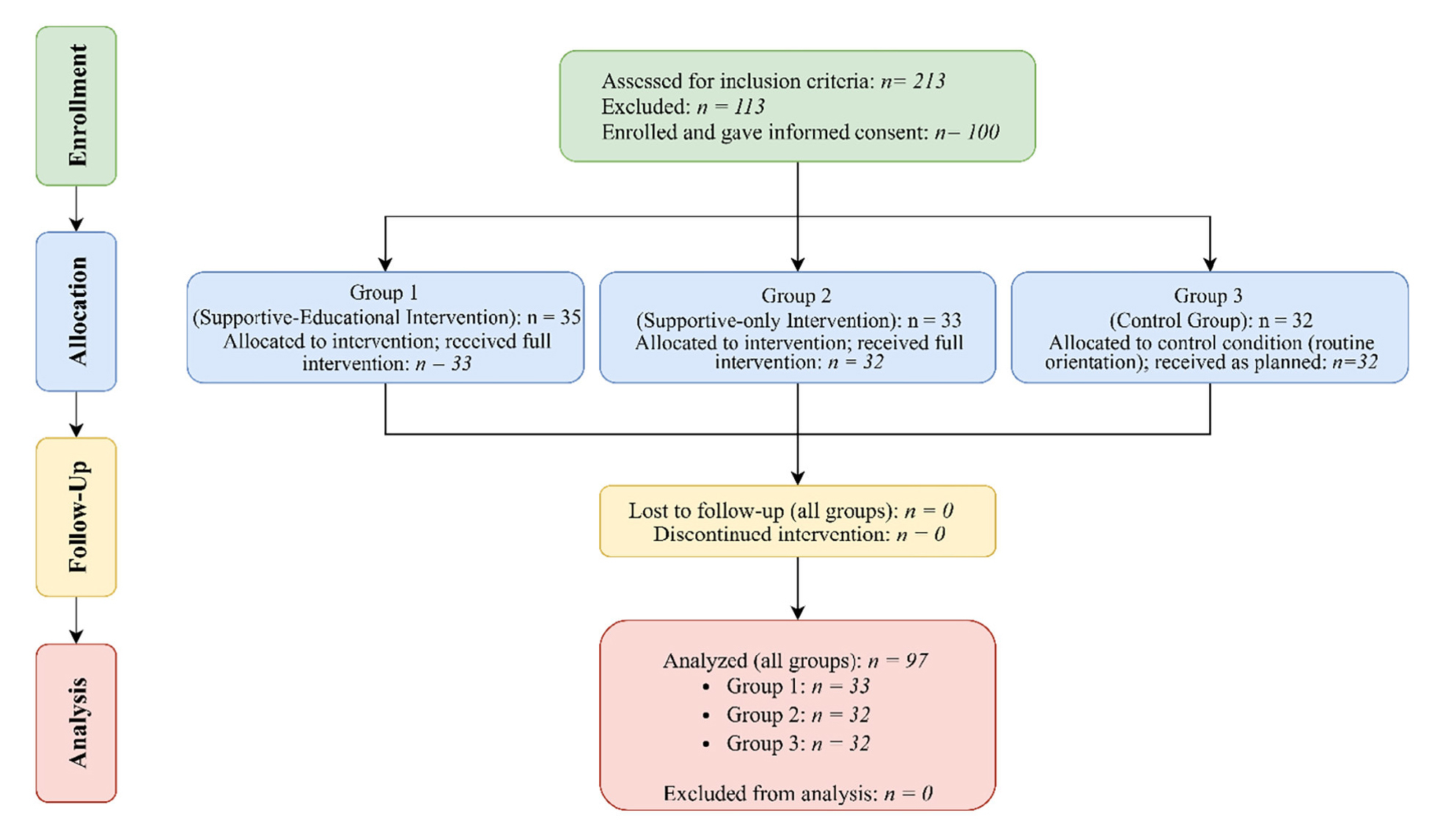
Figure 1. CONSORT Flow Diagram
Results
Most of the participants in all three groups were female. The median age of novice nurses was 24 years (IQR=2) in the first intervention group, 24 years (IQR=2) in the second intervention group, and 23.5 years (IQR=1.5) in the control group. According to the Kruskal-Wallis test, there was no statistically significant difference between the groups in terms of age (p=0.262).
Statistical analysis indicated that the three groups were homogeneous in terms of key demographic characteristics, including gender, age, marital status, degree of education, student work experience, grade point average, university and city of study, priority in choosing nursing as a field, level of interest in the profession, and intention to change jobs in the future (p>0.05). However, the groups were not homogeneous in terms of prior work experience. The Kruskal-Wallis test revealed a statistically significant difference in their previous work experience among the groups (p<0.001) (Table 2).
| Variables | First intervention group (supportive-educational) (n=33) | Second intervention group (supportive-only) (n=32) | Control group (n=32) | Test | P | ||
|---|---|---|---|---|---|---|---|
| Gender | Male | N (%) | 14 (45.16) | 7 (22.58) | 10 (32.26) | Chi-square | 0.205 |
| Female | 19 (28.29) | 25 (37.88) | 22 (33.33) | ||||
| Age | Years | P50 (IQR) | 24 (2) | 24 (2) | 23.5 (1.5) | Kruskal Wallis | 0.262 |
| Marital status | Single | N (%) | 19 (39.58) | 11 (22.92) | 18 (37.50) | Chi-square | 0.112 |
| Married | 14 (28.57) | 21 (42.86) | 14 (28.57) | ||||
| Degree of education | Bachelor | N (%) | 32 (32.685) | 32 (32.68) | 31 (32.63) | Chi-square | 0.407 |
| Master | 0 (0.00) | 0 (0.00) | 1 (100.00) | ||||
| MSc Student | 1 (100.00) | 0 (0.00) | 0 (0.00) | ||||
| Student work experience | Yes | N (%) | 17 (41.46) | 14 (34.15) | 10 (24.39) | Chi-square | 0.249 |
| No | 16 (28.57) | 18 (32.14) | 22 (39.29) | ||||
| Grade point average | 0 to 20 Units | P50 (IQR) | 16.71 (1.4) | 16.82 (1.99) | 17 (1.06) | Kruskal Wallis | 0.903 |
| University type | Azad | N (%) | 17 (30.91) | 17 (30.91) | 21 (38.18) | Chi-square | 0.457 |
| Governmental | 16 (38.10) | 15 (35.71) | 11 (26.19) | ||||
| City of education | Mashhad | N (%) | 13 (30.95) | 15 (35.71) | 14 (33.33) | Chi-square | 0.829 |
| Township | 20 (36.36) | 17 (30.91) | 18 (32.73) | ||||
| Interest level in the profession | 0 to 10 Units | Mean (SD) | 7.63 (2.05) | 7.59 (1.73) | 6.93 (1.72) | One-way | 0.240 |
| Intention to change jobs | Yes | N (%) | 13 (32.50) | 12 (30.00) | 15 (37.50) | Chi-square | 0.722 |
| No | 20 (35.09) | 20 (35.09) | 17 (29.82) | ||||
| Work experience | Week | P50 (IQR) | 9 (14) | 27.5 (25) | 9 (5.5) | Kruskal Wallis | <0.001 |
| P50: Median; IQR: Interquartile range; Levels of significance: P<0.05 | |||||||
Intra-group comparisons revealed significant improvements in competency scores within both intervention groups. In the first intervention group, the mean competency score increased from 49.60 units (SD=16.08) to 73.39 units (SD=9.66) (P 0.001). In the second intervention group, the mean score rose from 63.96 units (SD=12.73) to 70.90 units (SD=10.86) (P=0.001). In contrast, the control group showed no significant change, with a mean score increasing only slightly from 64.34 units (SD=15.18) to 65.78 units (SD=12.06) (P=0.228) (Table 3).
| Dimensions of competence | Group | Mean (SD)/ p50 (IQR) Before intervention | Mean (SD)/ p50 (IQR) After intervention | Test | P |
|---|---|---|---|---|---|
| Assessment | First intervention | 6.51 (2.53) | 9.36 (1.36) | T-test | <0.001 |
| Second intervention | 8.21 (2.09) | 9.50 (1.68) | T-test | 0.002 | |
| Control | 8.28 (2.03) | 8.78 (1.73) | T-test | 0.057 | |
| Communication | First intervention | 11.36 (3.77) | 16.24 (2.29) | T-test | <0.001 |
| Second intervention | 15.03 (3.14) | 16.18 (2.76) | T-test | 0.025 | |
| Control | 15.25 (3.49) | 15.15 (2.82) | T-test | 0.583 | |
| Clinical Judgment | First intervention | 23.25 (5.79) | 25.09 (4.95) | T-test | <0.001 |
| Second intervention | 24 (7) | 26 (6) | T-test | 0.028 | |
| Control | 23.75 (6.70) | 23.56 (5.58) | T-test | 0.577 | |
| Patient Safety | First intervention | 15 (4) | 19 (4) | Wilcoxon | <0.001 |
| Second intervention | 17 (5) | 19.5 (6) | Wilcoxon | <0.001 | |
| Control | 17.06 (4.05) | 18.28 (3.23) | T-test | 0.017 | |
| Total Competency Score | First intervention | 49.60 (16.08) | 73.39 (9.66) | T-test | <0.001 |
| Second intervention | 63.96 (12.73) | 70.90 (10.86) | T-test | 0.001 | |
| Control | 64.34 (15.18) | 65.78 (12.06) | T-test | 0.228 | |
| P50: Median; IQR: Interquartile range; Levels of significance: P<0.05 | |||||
Inter-group comparisons revealed that the change in the mean competency scores was greatest in the first intervention group, 23.78 units (SD=21.26), followed by the second intervention group, 6.93 units (SD=12.06), and the control group, 1.43 units (SD=10.79). The results of the Kruskal-Wallis test indicated a statistically significant difference in the mean change of competency scores among the three groups (p<0.001). Post-hoc analysis showed that there was a statistically significant difference in the mean change of competency scores between the first intervention group and the second intervention group (p<0.001), as well as between the first intervention group and the control group (p<0.001). However, no statistically significant difference was found between the second intervention group and the control group (p=0.478) (Table 4).
| Dimensions of competence | Time | Mean (SD) / p50 (IQR) | Test / post hoc test | P-value | P-value in post hoc test | ||||
|---|---|---|---|---|---|---|---|---|---|
| First intervention | Second intervention | Control | 1 vs 2 | 1 vs 3 | 2 vs 3 | ||||
| Assessment | Before | 6.51 (2.53) | 8.21 (2.09) | 8.28 (2.03) | One way/ Bonferroni | 0.002 | 0.008 | 0.006 | 1.000 |
| After | 9.36 (1.36) | 9.50 (1.68) | 8.78 (1.73) | One way/ Bonferroni | 0.167 | - | - | - | |
| Difference | 2.84 (2.80) | 1.28 (2.43) | 0.50 (1.74) | One way/ Bonferroni | <0.001 | 0.028 | <0.001 | 0.575 | |
| Communication | Before | 11.36 (3.77) | 15.03 (3.14) | 15.25 (3.49) | One way/ Bonferroni | <0.001 | <0.001 | <0.001 | 1.000 |
| After | 16.24 (2.29) | 16.18 (2.76) | 15 (4.5) | One way/ Bonferroni | 0.126 | - | - | - | |
| Difference | 5.06 (4.80) | 1.15 (3.23) | -0.9 (2.50) | One way/ Bonferroni | <0.001 | <0.001 | <0.001 | 0.524 | |
| Clinical Judgment | Before | 18.00 (6.66) | 23.25 (5.79) | 23.75 (6.70) | One way/ Bonferroni | <0.001 | 0.004 | 0.001 | 1.000 |
| After | 27.69 (4.04) | 25.09 (4.95) | 23.56 (5.58) | One way/ Bonferroni | 0.003 | 0.104 | 0.003 | 0.641 | |
| Difference | 9.69 (8.83) | 1.84 (5.27) | -0.18 (5.34) | One way/ Bonferroni | <0.001 | <0.001 | <0.001 | 0.690 | |
| Patient Safety | Before | 15 (4) | 17 (5) | 17.5 (6.5) | Kruskal Wallis / Dunnett | 0.001 | - | 0.001 | 0.879 |
| After | 19 (4) | 19 (6) | 17.5 (5.5) | Kruskal Wallis / Dunnett | 0.024 | - | 0.065 | 0.034 | |
| Difference | 5 (7) | 2 (3.5) | 2 (4) | Kruskal Wallis/ Dunnett | <0.001 | - | <0.001 | 0.308 | |
| Total Competency Score | Before | 49.60 (16.08) | 63.96 (12.73) | 64.34 (15.18) | One way/ Bonferroni | <0.001 | <0.001 | <0.001 | 1.000 |
| After | 73.39 (9.66) | 70.90 (10.86) | 65.78 (12.06) | One way/ Bonferroni | 0.019 | 1.000 | 0.018 | 0.189 | |
| Difference | 23.78 (21.26) | 6.93 (12.06) | 1.43 (10.79) | One way/ Bonferroni | <0.001 | <0.001 | <0.001 | 0.478 | |
| P50: Median; IQR: Interquartile range; Levels of significance: P<0.05 | |||||||||
After adjusting the baseline competency scores and confounding variables using multiple quantile regression and multiple linear regression (Table 5), the mean post-intervention competency score in the first intervention group was significantly higher than in the control group by 10.86 units (P=0.034). In the second intervention group, the mean score was 5.20 units higher than the control group, and this difference was statistically significant (P=0.049).
| Dimensions of competence | Group | Crude | Adjusted | Test | ||||
|---|---|---|---|---|---|---|---|---|
| Coef. | CI 95% | P | Coef. | CI 95% | P | |||
| Control | Reference | |||||||
| Assessment | First intervention | 0.58 | (-0.20,1.37) | 0.146 | 0.90 | (0.11,1.69) | 0.025 | Multiple Linear Reg. |
| Second intervention | 0.71 | (-0.07,1.51) | 0.076 | 0.87 | (0.11,1.64) | 0.025 | Multiple Linear Reg. | |
| Communication | First intervention | 1.26 | (-0.03,2.56) | 0.056 | 2.18 | (0.81,3.55) | 0.002 | Multiple Linear Reg. |
| Second intervention | 1.03 | (-0.27,2.33) | 0.121 | 1.08 | (-0.16,2.33) | 0.089 | Multiple Linear Reg. | |
| Clinical Judgment | First intervention | 4.13 | (1.72,6.54) | 0.001 | 5.51 | (3.06,7.97) | <0.001 | Multiple Linear Reg. |
| Second intervention | 1.53 | (-0.89,3.95) | 0.214 | 1.65 | (-0.66,3.96) | 0.160 | Multiple Linear Reg. | |
| Patient Safety | First intervention | 1.00 | (-1.51,3.51) | 0.432 | 2.14 | (-0.27,4.56) | 0.082 | Multiple Quantile Reg. |
| Second intervention | 2.00 | (-.053,4.53) | 0.121 | 1.42 | (-0.86,3.72) | 0.220 | Multiple Quantile Reg. | |
| Total competency score | First intervention | 7.61 | (2.24,12.98) | 0.006 | 10.86 | (5.28,16.44) | <0.001 | Multiple Linear Reg. |
| Second intervention | 5.12 | (-0.28,10.53) | 0.063 | 5.20 | (0.01,10.39) | 0.049 | Multiple Linear Reg. | |
| Levels of significance: P < 0.05 | ||||||||
The results of the multiple quantile regression analysis highlight that the first intervention was particularly and significantly more effective for nurses who initially expressed a low level of interest in the nursing profession (P=0.006) (Table 6).
| Group | Low level of interest in the profession | Moderate level of interest in the profession | High level of interest in the profession | ||||||
|---|---|---|---|---|---|---|---|---|---|
| Coef. | CI 95% | P | Coef. | CI 95% | P | Coef. | CI 95% | P | |
| Control | Reference | ||||||||
| First intervention | 20.53 | (6.50,34.56) | 0.006 | -6.40 | (-29.33,16.52) | 0.543 | 9.29 | (-3.41,22.00) | 0.148 |
| Second intervention | 11.53 | (-3.45,26.52) | 0.126 | -10.15 | (-29.80,9.49) | 0.273 | 5.64 | (-7.06,18.35) | 0.376 |
| Levels of significance: P<0.05 | |||||||||
Discussion
The findings of this study demonstrate that both in-service supportive-educational and supportive-only programs significantly enhanced the competency of novice nurses. Although the supportive-only program had a statistically significant positive impact on competency compared to the control group, the changes observed were less pronounced than those in the supportive-educational program. This difference may be due to the use of a supportive-only program, without the combination of targeted and structured educational components. While supportive-educational programs can more effectively contribute to competency development, supportive-only programs may have more limited results in improving competencies. Notably, supportive-educational intervention was especially effective among nurses who initially reported a low level of interest in the nursing profession. Mentoring can enhance the clinical learning environment (CLE); specifically, the structured nature of mentor–mentee interactions has been shown to align the learners’ perceptions of the CLE with those observed in the groups supervised by expert educators ( 30 ). Such perceptual convergence may serve as a foundation for competency development and provide impetus for substantial advances in clinical capabilities.
In a study by Spector, et al. (2015), significant improvement in nursing competency was observed after six months of program implementation ( 31 ). In contrast, our study revealed measurable improvements after only six weeks of support and education, highlighting the efficiency of the implemented intervention. Moreover, our findings align with the results of Rush, et al. (2019), emphasizing the importance of structured supportive programs in improving the competency of novice nurses ( 32 ). Similarly, Marks-Maran, et al. (2013) reported that a six-month preceptorship program enhanced both clinical and communication competencies ( 20 ). Our study supports these findings, even with a shorter intervention period of one and a half months. Notably, competency in our study was assessed by head nurses, providing a more objective evaluation compared to self-reported methods.
Results from the study of Tsang, et al. (2016) also confirmed the improvement in the clinical competence of novice nurses ( 33 ). Supporting the transition phase of novice nurses by implementing a mentorship program for ten months showed that there was a significant increase in competency in four dimensions: planning and evaluation, patient care, discipline and care leadership, but there was no statistically significant difference in communication ( 9 ). In our study, six weeks of the supportive-educational program implementation led to an increase in total competency score. After adjusting through pre-intervention scores, no statistically significant difference was observed in the patient safety dimension. This may be due to the complexity of patient safety behaviors, which involve not only individual skills but also adherence to organizational protocols and interprofessional communication, which potentially limit immediate measurable improvements.
Implementation of a supportive program increases the clinical competency of novice nurses ( 34 ). In addition, the implementation of a mentorship program for novice nurses showed a significant increase in competency after 6 and 12 months compared to the first 6 months. The present study also utilized the orientation and mentorship program and highlighted an increase in the novice nurses' competency. However, in the present study, head nurses performed the competency assessment, unlike self-reporting in other studies ( 35 ). A manager's evaluation has more credibility than the self-reporting method ( 10 ). Providing a mentorship program even for a month to enhance competency in novice nurses increases the competency in all dimensions, including patient care, communication, decision-making, problem-solving, development, and commitment to quality ( 36 ). This study was also accompanied by an increase in the novice nurses' competency using the mentorship method. The study by Kowalski and Cross (2010) on the preliminary effect of the implementation of a local residency program in novice nurses for two months indicated that the process of increasing competency over time was positive and significant ( 21 ). A limitation of their program was the absence of a control group. Like our study, using in-service programs was associated with an increase in the novice nurses' competency, but we conducted the study in three groups (two intervention groups and a control group).
The study by Chen, et al. (2021) showed that supportive programs through preceptorship had a significant impact on the competency of newly graduated registered nurses. The study found that preceptor support was positively correlated with nursing competency, and nurses who received more support reported higher competency scores. This study used a self-report tool to assess competency. Regression analysis revealed that the key predictors of nursing competency were preceptor support, the consistency of the assigned preceptor, and the emotional aspects of transition shock, accounting for 34% of the variance in nursing competency ( 37 ). In comparison to the study by Chen, et al., one of the differences between the two studies lies in how competence was assessed. While Chen’s study used a self-report tool to assess competency, our study assessed the competency of newly graduated nurses from the perspective of their managers (head nurses). This difference might have led to more accuracy and impartiality in the assessments, as manager evaluations are less likely to be influenced by personal biases.
Lindfors, et al. (2022) showed that the preceptor intervention had no significant impact on the professional competence development of newly graduated nurses. In this quasi-experimental longitudinal study, the intervention and control groups were compared. The intervention group received an eight-hour training session on new employee orientation, but the results revealed no significant differences in competence development between the two groups. Newly graduated nurses in both groups rated themselves as the most competent in the Helping Role and the least competent in Therapeutic Interventions ( 38 ). Although the studies by Lindfors et al. and Chen et al. utilized preceptor programs while our study focused on mentorship, both types of programs share significant similarities, as they are both considered supportive programs. In line with the systematic review by Abdollahi and Heshmati Nabavi (2023), such variations in outcomes may be explained by differences in program design and the level of organizational support provided ( 39 ).
In summary, the findings of this study indicate that both supportive-educational and supportive-only programs effectively enhance the competency of novice nurses, with the combined supportive-educational intervention producing more pronounced improvements. These results underscore the value of structured support and targeted education in improving the clinical competency of novice nurses.
Research limitations
The potential influence of mentor characteristics on the effectiveness of the intervention could not be fully controlled. The study was conducted during the late phase of the COVID-19 pandemic, which may have affected the participants’ experiences, workload, and engagement, potentially influencing the outcomes.
Conclusion
The supportive-educational program demonstrated significant improvements in competency compared to the control group and produced more pronounced effects than the supportive-only intervention. Notably, the supportive-only program also yielded measurable benefits, highlighting that both approaches can positively influence the novice nurses’ clinical competency. These findings suggest that hospitals and, particularly, nurse managers can adopt either program to support novice nurses in their transition to professional practice, with the choice depending on institutional resources, staff availability, and contextual needs.
Further research is recommended to explore how such programs can be optimized based on the nurses' level of interest in the profession, and to directly compare the supportive-educational and supportive-only interventions to determine their relative effectiveness across different clinical settings.
Acknowledgements
This article is based on the master’s thesis work of the first author (Samaneh Ghorbani), conducted at Mashhad University of Medical Sciences, Mashhad, Iran.
Authors’ Contribution
S.Gh designed and conceptualized the study as part of her thesis, conducted data collection, drafted the initial manuscript, and approved the final version. M.A.K contributed to data analysis and interpretation, drafted all parts of the manuscript, critically revised its content, and approved the final version. M.NML contributed to writing and critically revising the manuscript for intellectual content and approved the final version. F.HN supervised, designed and conceptualized the study, oversaw the interpretation of data, ensured ethical and scientific integrity, critically revised the manuscript, and approved the final version. H.HM provided statistical expertise, guided data analysis, contributed to interpreting the findings and approved the final version.
Conflict of interest
The authors declare that they have no conflict of interest.
Declaration on the use of AI
No artificial intelligence (AI) tools were used in the preparation, writing, data analysis, or editing of this manuscript.
References
- Zhang B, Ma QY, Cui XS, Xiao QG, Jin HY, Chen X, et al. Effectiveness of experiential teaching method on the development of nursing students’ skill competence: a systematic review and meta-analysis. Front Nurs. 2021; 7(4):359-68.
- Hayden J, Keegan M, Kardong-Edgren S, Smiley RA. Reliability and validity testing of the Creighton Competency Evaluation Instrument for use in the NCSBN National Simulation Study. Nursing Education Perspectives. 2014; 35(4):244-52.
- Jafari GN, Vanaki Z, Memarian R. Organizing “nursing mentors committee”: an effective strategy for improving novice nurses’clinical competency. Iranian Journal of Medical Education. 2008; 7(2):237-47.
- Competency: A concept analysis. Nursing forum. 2008; 43(4):214-22.
- Huston CJ. Leadership Roles and Management Functions in Nursing: Theory and Application. USA: Wolters Kluwer Health; 2022.
- Ankers MD, Barton CA, Parry YK. A phenomenological exploration of graduate nurse transition to professional practice within a transition to practice program. Collegian. 2018; 25(3):319-25.
- Maria HSY, Mei WL, Stanley L. The transition challenges faced by new graduate nurses in their first year of professional experience. GSTF Journal of Nursing and Health Care (JNHC). 2020; 5(1):1-7.
- Powers K, Herron EK, Pagel J. Nurse preceptor role in new graduate nurses' transition to practice. Dimensions of Critical Care Nursing. 2019; 38(3):131-6.
- Dyess S, Parker CG. Transition support for the newly licensed nurse: A programme that made a difference. Journal of Nursing Management. 2012; 20(5):615-23.
- Edwards D, Hawker C, Carrier J, Rees C. A systematic review of the effectiveness of strategies and interventions to improve the transition from student to newly qualified nurse. International journal of nursing studies. 2015; 52(7):1254-68.
- Fukada M. Nursing competency: Definition, structure and development. Yonago acta medica. 2018; 61(1):001-7.
- Herleth A, Virkstis K, Renfroe J, Rewers L. The challenging road to clinical competence for new graduate RNs. JONA: The Journal of Nursing Administration. 2020; 50(4):185-6.
- Hickey MT. Baccalaureate nursing graduates' perceptions of their clinical instructional experiences and preparation for practice. Journal of professional nursing. 2010; 26(1):35-41.
- Hampton KB, Smeltzer SC, Ross JG. The transition from nursing student to practicing nurse: An integrative review of transition to practice programs. Nurse Education in practice. 2021; 52:103031.
- Ashraf A, Hamid HM, Taghi SM, Fatemeh H. The public nursing image as perceived by nurses and citizens: A questionnaire survey. Int J Car Sci. 2020; 13(3):1611.
- Heshmati-Nabavi F, Vanaki Z. Professional approach: The key feature of effective clinical educator in Iran. Nurse Education Today. 2010; 30(2):163-8.
- Higgins G, Spencer RL, Kane R. A systematic review of the experiences and perceptions of the newly qualified nurse in the United Kingdom. Nurse Education Today. 2010; 30(6):499-508.
- Hoseinpour Z, Heshmati Nabavi F, Emami Moghaddam Z, Behnam Vashani HR, Hasanzadeh F. Comparing professional confidence in midwifery students and clinical midwives. 2014; 14(2):137-47.
- Irwin C, Bliss J, Poole K. Does preceptorship improve confidence and competence in newly qualified nurses: A systematic literature review. Nurse education today. 2018; 60:35-46.
- Marks-Maran D, Ooms A, Tapping J, Muir J, Phillips S, Burke L. A preceptorship programme for newly qualified nurses: a study of preceptees' perceptions. Nurse education today. 2013; 33(11):1428-34.
- Kowalski S, Cross CL. Preliminary outcomes of a local residency programme for new graduate registered nurses. Journal of Nursing Management. 2010; 18(1):96-104.
- Logina A, Traynor M. The relationship between effective transition models and the optimal management of patient care. British Journal of Nursing. 2019; 28(3):168-73.
- Makarem A, Heshmati-Nabavi F, Afshar L, Yazdani S, Pouresmail Z, Hoseinpour Z. The comparison of professional confidence in nursing students and clinical nurses: A cross-sectional study. Iranian Journal of Nursing and Midwifery Research. 2019; 24(4):261-7.
- Nabavi FH, Vanaki Z, Mohammadi E. Systematic review: process of forming academic service partnerships to reform clinical education. Western journal of nursing research. 2012; 34(1):118-41.
- Aliyari N, Fallahi Khoshknab M, Khankeh H, Hoseini M, Yazdani M. The effectiveness of cognitive behavioral group intervention on the stress levels of new graduate nurses. Iran Journal of Nursing. 2015; 28(93):11-21.
- Rafii F, Sajadi Hezaveh M, Seyedfatemi N, Reaei M. Nurse managers' strategies for facilitating transition process newly nurses to clinical nurses. Quarterly journal of nursing management. 2015; 4(2):1.
- Evans K, Guile D, Harris J, Allan H. Putting knowledge to work: A new approach. Nurse Education Today. 2010; 30(3):245-51.
- Zamanzadeh V, Roshangar F, Valizadeh L, FathiAzar E. The challenges of newly graduated nurses for gaining competence in clinical judgment: A qualitative study. The Journal of Urmia Nursing and Midwifery Faculty. 2014; 12(2):117-28.
- Blanchard KH, Johnson DE. Management of organizational behavior: Leading human resources. USA: Pearson Prentice Hall; 2008.
- Heshmati Nabavi F, Shariat Safa F, Rajabpour M. The Effect of Mentoring Novice Clinical Educators on the Perception of Nursing Students from the Clinical Learning Environment. Journal of Advances in Medical Education & Professionalism. 2023; 11(4):252-61.
- Spector N, Blegen MA, Silvestre J, Barnsteiner J, Lynn MR, Ulrich B, et al. Transition to practice study in hospital settings. Journal of Nursing Regulation. 2015; 5(4):24-38.
- Rush KL, Janke R, Duchscher JE, Phillips R, Kaur S. Best practices of formal new graduate transition programs: An integrative review. International journal of nursing studies. 2019; 94:139-58.
- Tsang LF, Sham A, Law SLW, Chan YM, Sze CY. ToUCH Program on competence, occupational stress and self-efficacy of newly graduated registered nurses in United Christian Hospital: A mixed method research study. Journal of Nursing Education and Practice. 2016; 6(8):129-37.
- van Rooyen DR, Jordan PJ, ten Ham-Baloyi W, Caka EM. A comprehensive literature review of guidelines facilitating transition of newly graduated nurses to professional nurses. Nurse Education in Practice. 2018; 30:35-41.
- Widarsson M, Asp M, Letterstål A, Källestedt M-LS. Newly graduated Swedish nurses' inadequacy in developing professional competence. The Journal of Continuing Education in Nursing. 2020; 51(2):65-74.
- Wilson T, Weathers N, Forneris L. Evaluation of outcomes from an online nurse residency program. JONA: The Journal of Nursing Administration. 2018; 48(10):495-501.
- Chen F, Liu Y, Wang X, Dong H. Transition shock, preceptor support and nursing competency among newly graduated registered nurses: A cross-sectional study. Nurse Education Today. 2021; 102:104891.
- Lindfors K, Flinkman M, Kaunonen M, Huhtala H, Paavilainen E. New graduate registered nurses’ professional competence and the impact of preceptors’ education intervention: a quasi-experimental longitudinal intervention study. BMC Nursing. 2022; 21(1):360.
- Abdollahi M, Heshmati Nabavi F. Mentoring as an Appropriate Strategy for Medical Faculty Member Development in Higher Education: A Systematic Review. Journal of Advances in Medical Education & Professionalism. 2023; 11(1):3-14.

