
Introduction
Professionalism is defined as the ‘aspiration toward altruism, accountability, excellence, duty, service, honor, integrity, and respect for others’ ( 1 ). It is a core competency and is fundamental to medical education and practice, as laid down by various accrediting and regulatory bodies across the globe. These include the American Board of Internal Medicine (ABIM), the American Association of Medical Colleges, and the Accreditation Council for Graduate Medical Education (ACGME), the European Federation of Internal Medicine and General Medical Council of United Kingdom ( 2 ). However, it is also the most challenging competency in terms of its teaching, assessment, management, and remediation with variable approaches ( 3 , 4 ). Regardless of the practice settings, certain skills and attributes like professionalism, work ethics, and integrity are deemed crucial for the new hires in Pathology. A survey of employer expectations from newly trained pathologists identified professionalism as a ‘critically important’ attribute and poor professionalism as a ‘red flag’ ( 5 ). It can be very difficult to recognize and manage professionalism issues which are common in residency trainings and Pathology residency programs that are not an exception ( 3 , 4 ). Professionalism and ethical issues such as those related to honesty and integrity, recognizing and reporting medical errors, inappropriate behavior and conflicts in interpersonal interactions, and conflicts of interest are reported to be some of the most important issues in residency training including pathology ( 3 ). A well-structured mentoring, remediation, and probation plan is integral to teach and assess professionalism ( 6 ). The appraisal of professional behavior and attitudes of residents and a formally structured remediation and course of action plan, with timely feedback to residents, is integral to inculcate professionalism ( 6 , 7 ). Students’ attitudes regarding professionalism develop partly from the formal curriculum but mainly and always from their observations as part of the hidden curriculum ( 2 , 8 ). While students’ exposure to variety of encounters and experiences is considered necessary to teach professionalism, this can also be augmented with experience and reflection from simulations, small group or case-based discussions, case vignettes, role plays, etc. ( 2 , 7 ). In March 2017, the ACGME updated its professionalism common program requirements and recently formulated professionalism milestones in pathology residents which include professional behavior and ethical principles, accountability and conscientiousness, self-awareness, and help-seeking ( 9 ). New interest and vigor has been prompted in defining, teaching, and assessing professionalism, as well as in approaches to manage and remediate unprofessional behavior. This is due to the recent modification by ACGME in core competencies and milestones of ACGME-accredited residency and fellowship training programs ( 10 ). Pakistan Medical and Dental Council, and the College of Physicians and Surgeons of Pakistan (CPSP) has also proposed to formally assimilate the elements of professionalism in undergraduate as well as post-graduate medical education and training in Pakistan ( 11 , 12 ). However, most institutions in Pakistan still lack formal teaching/learning and assessment of professionalism both for undergraduate and postgraduate medical education programs ( 13 ). Moreover, there is dearth of literature regarding teaching professionalism to pathology residents and evaluation of their attitudes or behaviors in this regard, in both local and international contexts ( 12 , 14 ). Hence, a case-based interactive workshop on professionalism for pathology residents was conducted at a private medical college in Karachi, Pakistan, with the aim of improving their knowledge and perception about professionalism, its issues, and management.
The purpose of this study was to determine the effectiveness of this workshop by determining any change in their perception and attitude towards professionalism through pre- and post-test and to determine and compare the responses of the faculty and residents for the appropriate course of action in case of professionalism lapses in the given case-scenarios.
Methods
Study Design and Participants: A quasi-experimental pre-post design study was conducted that included a census sample of all pathology residents from year 1-5 enrolled in Pathology residency program at the Aga Khan University (AKU), Karachi, Pakistan. All residents that were currently under training in the program were included in the study. Residents who had spent less than three months in training or residents with incomplete responses on the pre-post-test were excluded from the study.
This study was conducted at the Department of Pathology and Laboratory Medicine, AKU. The department offers a CPSP recognized, comprehensive 5-year training program in the four major disciplines of Pathology, including Chemical Pathology, Hematology, Histopathology, and Microbiology. The pathology core curriculum is designed to provide residents with a well-rounded education in the field, and the program is committed to using a variety of teaching/learning and assessment methods to achieve this goal. However, the curriculum lacks any structured formal teaching/learning or assessment of professionalism.
Development of case scenarios
Prior to the workshop, ten case scenarios with the list of possible course of action were developed, adapted, or modified from the literature, in accordance with our local context, with the permission of the original authors ( 3 , 4 , 8 , 10 ). The scenarios encompassed some of the common issues (such as confidentiality, honesty and integrity, respect, accountability, interpersonal skills, self-awareness, and wellbeing) related to professionalism in pathology residents. As part of departmental residency committee, residency program directors (PDs) and associate program directors of hematology, chemical pathology, microbiology, and histopathology were invited. Nominal Group Technique was used to seek consensus on the most appropriate course of action from the given list in managing the unprofessional behavior of a resident in the given scenarios ( 4 ). The consensus was reached through iterative discussion and feedback as opinions of the group members were obtained, with their consent to include the responses for the study.
Data collection
A workshop on professionalism in pathology residents was organized in August 2021. All pathology residents from Year 1-5 attended the workshop. A group of pathology residency PDs and coordinators were invited to the workshop as panelists for discussion. After we obtained informed consent to include their data in the study, the participants were administered the Penn State College of Medicine (PSCOM) professionalism questionnaire for residents as pre-test. The PSCOM professionalism questionnaire is a self-reporting, reliable, and validated tool, consisting of 36 items, grouped in six clusters with six items in each. It is used to assess the attitudes of the faculty, residents, and medical students, reflecting the ABIM’s six elements of professionalism including Accountability, Altruism, Duty, Excellence, Honesty, and Integrity and Respect ( 15 ). The tool has been used and validated in the local context of Pakistan in the literature ( 12 ). The residents were required to rate the extent to which each statement reflects their definition of professionalism on a five-point Likert scale (1=never, 2=little, 3=some, 4=much, and 5=great deal). Ten case scenarios were given to each participant for their responses on the scenario, regarding the appropriate course of action by the PD in managing the unprofessional behavior of a resident. The residents were required to mark their feedback as to what should be the most likely course of action taken by the PD to manage the unprofessional behavior of a resident in the given scenarios. Responses to both the pre-test and case-scenarios were collected immediately. The same case scenarios were then discussed in groups of participants and further deliberated with the insights from panelist on each scenario as an open discussion. At the end of the workshop, the participants were asked to complete the post-test PSCOM questionnaire. Feedback regarding the workshop and its effect on increasing their knowledge of professionalism, issues, and their possible remediation was obtained. The data were collected anonymously and were only accessible to the investigators.
Data Analysis
Data were analyzed using IBM Statistical Package for Social Sciences (SPSS) version 19. Mean scores and standard deviation (SD) were determined for the PSCOM questionnaire as pre-post-test. The participants’ responses on the case scenarios and their feedback regarding the workshop were analyzed using descriptive statistics. Data were analyzed using inferential statistics using paired T-test to compare the pre-post assessment scores of the participants, with a p-value of <0.05 as significant.
Ethical considerations
Ethical approval was obtained from the institutional Ethics Review Committee at AKU (ERC Ref. No.2021-6518-19358). The data were collected anonymously and were only accessible to the investigators. The study was conducted in line with the relevant guidelines and regulations. The workshop was provided as part of an educational service which aimed at academic support to the residents.
Results
Responses of 30 residents in residency years 1 to 5 were included in the study, while data from residents with incomplete responses on the pre-post-test were excluded from the study. The mean±SD of the participants’ age was 29.63±2.69 years and included 11 (36.7%) males, and 19 (63.3%) females. The distribution of participants between the sections of histopathology, hematology, microbiology, and chemical pathology is shown in Table 1.
| Specialty | Participants (N=30) |
|---|---|
| Histopathology | 14 |
| Heamatology | 7 |
| Microbiology | 5 |
| Chemical pathology | 4 |
Comparison of pre-test and post-test scores
The mean pre-test and post-test PSCOM score was 148.53±18.11 and 155.10±17.2, respectively (p-value=0.003).
Based on the ABIM, a priori six categories represented in the PSCOM questionnaire, data were also analyzed to determine the differences in the mean scores of pre-post-test of these categories. Although mean post-test scores were higher for all the six categories, the difference was statistically significant between the pre-post-test mean scores for altruism, duty, honor and integrity, and excellence, as shown in Table 2.
| Domain | Mean±SD | p | |
|---|---|---|---|
| Total | pretest | 148.53 ± 18.11 | 0.003 |
| post test | 155.10 ± 17.72 | ||
| Accountability | pretest | 24.83 ± 3.42 | 0.07 |
| post test | 25.63 ± 3.09 | ||
| Honor and Integrity | pretest | 24.70 ± 3.72 | 0.03 |
| post test | 25.93 ± 3.53 | ||
| Excellence | pretest | 24.03 ± 3.82 | 0.01 |
| post test | 25.33 ± 3.45 | ||
| Duty | pretest | 23.93 ± 3.76 | 0.008 |
| post test | 25.20 ± 3.52 | ||
| Altruism | pretest | 24.93 ± 3.26 | 0.01 |
| post test | 26.16 ± 3.18 | ||
| Respect | pretest | 26.10 ± 3.19 | 0.15 |
| post test | 26.83 ± 3.17 | ||
Responses for Management of Unprofessional Behavior
Responses in terms of their opinion were determined from the residents and are reported as percentages regarding the most appropriate course of action for management of unprofessional behavior in the given case scenarios. In five out of ten scenarios, most of the residents’ responses were like the proposed faculty consensus, as detailed in Table 3. The percentages of residents whose response matched that of the faculty are presented in Figure 1.
| Cases | Percentage of most common resident response |
|---|---|
| Authorship credit claim in a research publication by PGY5 | |
| FACULTY: Place on probation | |
| RESIDENT: Determine formal remediation plan and follow-up | 60 |
| Deliberate sign-out of report with wrong EMR number by PGY4 | |
| FACULTY: Determine formal remediation plan and follow-up | |
| RESIDENT: Determine formal remediation plan and follow-up | 53.3 |
| Inappropriate error disclosure, misinformation by PGY4 | |
| FACULTY: Immediately dismiss | |
| RESIDENT: Determine formal remediation plan and follow-up | 43.3 |
| Inappropriate use of social media by PGY1 | |
| FACULTY: Determine formal remediation plan and follow-up | |
| RESIDENT: Determine formal remediation plan and follow-up | 50 |
| Inapt behavior towards colleagues, staff and faculty by PGY 2 | |
| FACULTY: Determine formal remediation plan and follow-up | |
| RESIDENT: Determine formal remediation plan and follow-up | 33.3 |
| Irresponsible behavior and lack of task ownership and timely completion by PGY1 | |
| FACULTY: Do not renew contract | |
| RESIDENT: Determine formal remediation plan and follow-up | 30 |
| Lack of self-awareness and refusal to seek help by PGY1 | |
| FACULTY: Request fitness for duty evaluation | |
| RESIDENT: Meet informally to discuss, then monitor | 33.3 |
| Medical disorder resulting in performance and behavior issues by PGY2 | |
| FACULTY: Request fitness for duty evaluation | |
| RESIDENT: Request fitness for duty evaluation | 60 |
| Unauthorized access to EMR by PGY4 | |
| FACULTY: Determine formal remediation plan and follow-up | |
| RESIDENT: Meet informally to discuss, then monitor | 56.7 |
| Verbal abuse/ Failure to obtain informed consent by PGY3 | |
| FACULTY: Place on probation | |
| RESIDENT: Place on probation | 50 |
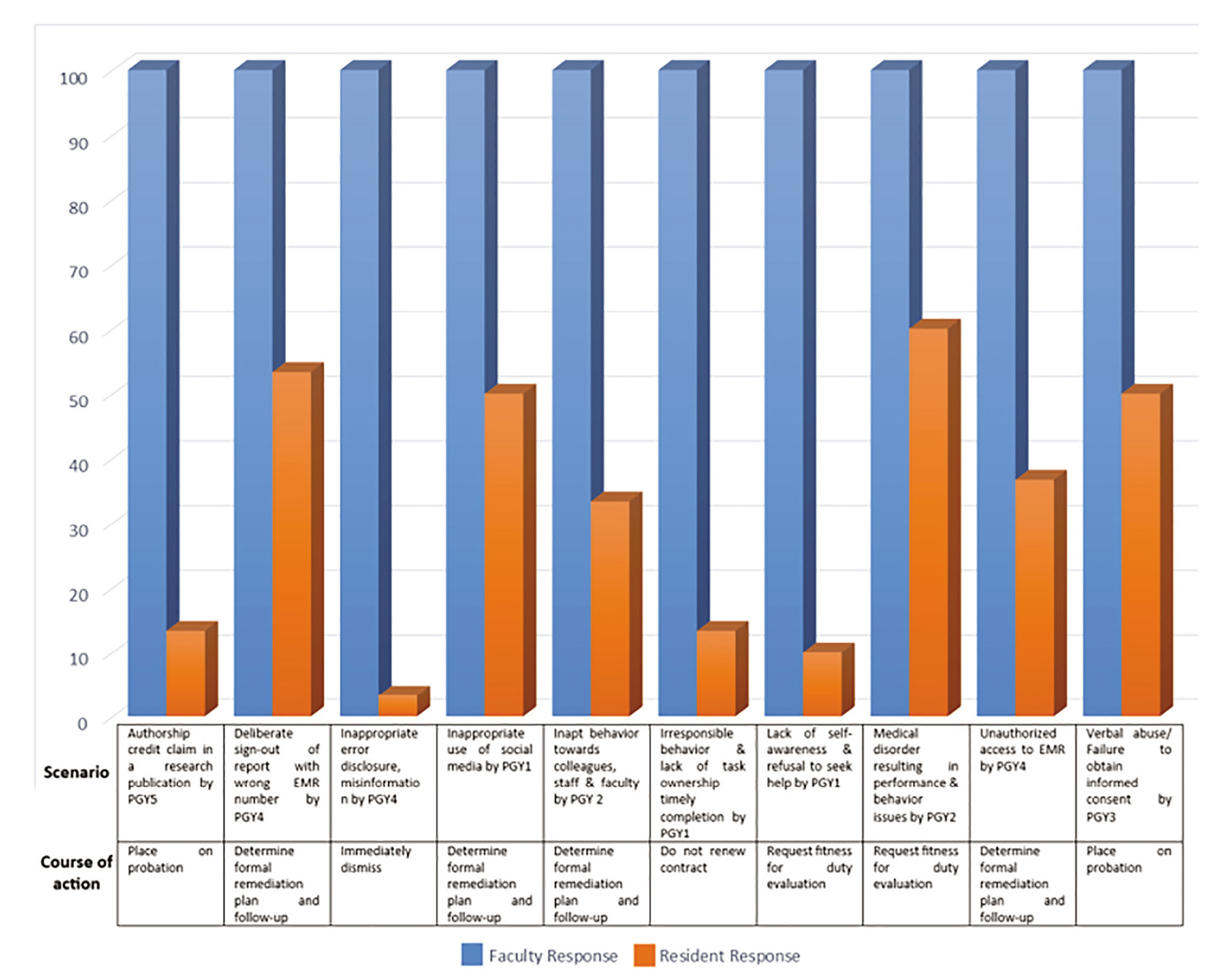
Figure 1. The percentage of matched responses of the Faculty and Residents for the course of action against unprofessional behavior. The cases and the response are listed below the graph
Feedback of the participants
The case-based interactive discussion was highly appreciated by the residents. 90% of the participants had not attended any session or workshop on professionalism program previously and rated their learning experience in this workshop as excellent/very good. The majority (86.7%) of the participants rated the workshop as excellent or very good in providing them with new knowledge, while 83.3% of them rated it as excellent/very good in improving their knowledge about professionalism and its attributes. 90% of the participants rated the workshop as excellent or very good in improving their knowledge of professionalism issues with their possible remediation actions in pathology residency. Most of the participants (93.4%) found the case scenarios discussed in workshop, as excellent/very good in being useful and related to their work practice. Residents also highlighted the needs and recommended a formal curriculum for professionalism in the pathology residency program. Some of the comments and feedback given by the majority of the participants in response to open-ended questions about what they liked the best about the workshop are listed below:
- •“Case-based practical scenarios, interactive discussion and solutions”
- •“Excellently organized, thoroughly interactive”
- •“Facilitators, cases, free discussion, new light on aspects of professionalism”
- •“Open discussion, helped to freely share the concerns and ethical dilemmas”
- •“Very interesting, gave new motivation and enthusiasm, realized the importance of professionalism”
Discussion
This study offers significant validation of professionalism practices through case-based approach that can guide the residents toward adopting a mindset more aligned with their clinical specialty.
The results of the study show a significant difference between the pre-test and post-test results, demonstrating the effectiveness of the case-based interactive workshop on professionalism for pathology residents. There is a growing consensus amongst medical educators to enhance professional development of medical students, and that medical schools should prepare formal teaching sessions to teach professionalism ( 16 ). The results of the survey that we conducted reveaed that 90% of the participants had never attended any session or workshop on professionalism previously, indicating a lack of structured professionalism training for residents.
The ACGME, responsible for resident training in the United States (US), included professionalism as one of the six core competencies to be taught and assessed among residents across all specialties ( 17 ). Goodwin, et al. discussed a professionalism objective structured clinical examination for medical students and reported changing perspectives of medical students regarding professional and the need for additional professionalism training at the undergraduate level ( 18 ). In contrast, Nah, et al. reported that emergency physicians in South Korea were well aware of what constituted unprofessional behavior; yet, many physicians reported they were either involved in or had observed such behavior ( 19 ). Ashwood, et al. implemented a workshop on 83 surgical trainees and trainers in the United Kingdom. They reported that most trainees felt that teaching non-technical skills adversely impacted their clinical performance ( 20 ). This notion of putting much emphasis on technical skills often leads to ignorance towards teaching and learning of non-technical skills, including professionalism.
We used a case-based approach as it can help the residents to recognize inappropriate behavior and help to define professionalism. The most difference between pre-test and post-test performance in our study was seen in the domains of duty and altruism. Kung et al reported high effectiveness of case-based curriculum to teach professionalism to residents, assessed using PSCOM questionnaire ( 21 ). They tested a year-long, case-based reflective practice curriculum on the attitudes of radiology residents about professionalism and found significant differences in the domains of duty, accountability, enrichment, honor and integrity between the pre- and post-test. Jauregui et al. performed a study on Emergency Medicine resident perception on professionalism and reported the highest value for the domains of respect and honor and integrity; in contrast to our study, they reported the lowest value for the domain of altruism ( 22 ). Alghulaydhawi et al. also used the same tool in Ophthalmology residents in Saudi Arabia and reported the highest score in the domain of respect and the lowest in the domain of altruism ( 23 ). Athy et al. performed a faculty versus resident self-assessment for Pathology residents in a US residency program using Pathology milestones and reported a significantly high discrepancy score for the professionalism component ( 24 ).
Ten cases were administered to the faculty and residents regarding management of unprofessional behaviour and their responses were compared. For those cases, the highest response by the residents only matched that of the faculty in 5 cases (Table 3). For the remaining cases, most of the residents opted to determine a formal remediation plan instead of immediate dismissal, place on probation, and do not renew contract, as opted by the faculty. This shows the residents’ intent to go for a lesser punishment as compared to the faculty. Domen, et al. developed and conducted 5 similar scenarios on the Pathology faculty and residents across the US ( 25 ). The responses showed a high level of agreement between the faculty and residents. They reported that a certain degree of generational differences was present between the faculty and the residents. The difference in our study could also be attributed to generational or role-based differences, but a lack of professionalism training in residents could also be the major cause of this difference. Formal training of professionalism can help bridge the gap between the residents’ and faculty’s understanding of professionalism and remediation of unprofessional behavior. Mak-van der Vossen et al. presented a roadmap for attending to medical students’ professionalism lapses ( 26 ). They developed a 3-phase approach for attending the professionalism lapses. Phases 1 and 2 aimed to keep the students in the medical community, while phase 3 aimed to guide them out. Teaching similar approaches to the residents could help them better handle professionalism lapses by their colleagues and trainees at a later stage of their career.
Strengths, Limitations and Future Directions
Contextual to the Department of Pathology and Laboratory Medicine at AKU, as one of the largest pathology residency programs in the country with residents from all over Pakistan, the study findings will serve as groundwork to develop and implement formal professionalism for various training programs. Moreover, it emphasizes the need for clearer guidelines on the ‘grey areas’ particularly in situations necessitating dismissal, beyond the straightforward cases involving confidentiality and patient safety.
The study had somelimitation due to small sample size and involvement of only Pathology residents within a single center. However, residents from all four sections within the Department of Pathology and Laboratory Medicine belonged to four independent residency tracks. It was further limited to being a one-time intervention due to which the effect measured can be considered as short term as the pre-post questionnaire was administered immediately before and after the half-day workshop. However, it can be the baseline or pilot for the development of the entire course in future. Inclusion of a longitudinal program would produce more sustainable and measurable outcomes. This workshop was also the first, to our knowledge, to compare the residents and faculty self-assessment regarding the course of action to manage unprofessional behavior in Pakistan.
A more holistic training and assessment program needs to be developed specific to each training program. The accrediting bodies involved in resident training in Pakistan should ensure that effective professionalism training is provided across the board for all residents as they become independent caregivers.
Conclusion
Authentic, real-life, and contextual case scenarios in a case-based workshop significantly improved the knowledge and perception of residents towards professionalism, its issues and management of lapses. Hence, case-based discussion could be a useful strategy in teaching professionalism to pathology residents.
Acknowledgement
The authors would like to acknowledge the participants and the panelist faculty who participated in the workshop.
Authors’ contribution
JR made substantial contributions to the conception and design of the work, contributed to analysis and interpretation of data, drafted the manuscript and substantively reviewed and revised it. KJ made substantial contributions to the conception and design of the work, and substantively reviewed the manuscript. MAA contributed to the writing and reviewed the manuscript. SIH contributed to the conception and design of the work and reviewed the manuscript. All authors have read, revised and approved the final manuscript.
Conflict of Interest
The authors declare that they have no competing interests.
Declaration of AI
No Artificial intelligence was used in the writing this work.
References
- Medicine ABoI. Project professionalism. USA: ABIM Philadelphia; 1995.
- Berger AS, Niedra E, Brooks SG, Ahmed WS, Ginsburg Sh. Teaching professionalism in postgraduate medical education: a systematic review. Acad Med. 2020; 95(6):938-46.
- Domen RE, Talbert ML, Johnson K, Post M, Brissette MD, Conran RM, et al. Assessment and management of professionalism issues in pathology residency training: results from surveys and a workshop by the Graduate Medical Education Committee of the College of American Pathologists. Acad Pathol. 2015; 2(3):2374289515592887.
- Domen RE, Johnson K, Conran RM, Hoffman RD, Post M, Steinburg JJ, et al. Professionalism in pathology: a case-based approach as a potential educational tool. Arch Pathol Lab Med. 2017; 141(2):215-9.
- Post MD, Johnson K, Brissette MD, Conran RM, Domen RE, Hoffman RD, et al. Employer expectations for newly trained pathologists: report of a survey from the Graduate Medical Education Committee of the College of American Pathologists. Arch Pathol Lab Med. 2017; 141(2):193-202.
- Domen RE. Resident remediation, probation, and dismissal basic considerations for program directors. Am J Clin Pathol. 2014; 141(6):784-90.
- Cruess RL, Cruess SR. Teaching professionalism: general principles. Med Teach. 2006; 28(3):205-8.
- Conran RM, Powell SZE, Domen RE, McCloskey CB, Brissette MD, Cohen DA, et al. Development of professionalism in graduate medical education: A case-based educational approach from the college of american pathologists’ graduate medical education committee. Acad Pathol. 2018; 5:2374289518773493.
- Accreditation Council on Graduate Medical Education. The pathology milestone project a joint initiative of the accreditation council for graduate medical education and The American Board of Pathology [Internet]. 2024 [Accessed: March, 2024]. Available from: https://www.acgme.org/Portals/0/PDFs/Milestones/PathologyMilestones.pdf
- Gronowski AM, McGill MR, Domen RE. Professionalism in residency training: A compilation of desirable behaviors and a case-based comparison between pathologists in training and practice. Acad Pathol. 2016; 3:2374289516667509.
- Gondal K, Khan J, Ahmed A. Measuring Professionalism In Residency Program. Biomedica. 2015; 31(3):1.
- Manzoor A, Baig LA, Aly SM. Attitudes of faculty and residents of surgical specialties towards professionalism at a tertiary care hospital of Islamabad. Pak J Med Sci. 2019; 35(2):371.
- Aleem SB, Raja AKF, Iqbal M, Naveed T, Yousaf I, Gul F. Knowledge of medical professionalism among the undergraduate students of army medical college, Rawalpindi. Pakistan Armed Forces Medical Journal. 2020; 70(5):1396-401.
- Brissette MD, Johnson KA, Raciti PM, McCloskey CB, Gratzinger D, Conran RM, et al. Perceptions of unprofessional attitudes and behaviors: implications for faculty role modeling and teaching professionalism during pathology residency. Arch Pathol Lab Med. 2017; 141(10):1394-401.
- Blackall GF, Melnick SA, Shoop GH, George J, Lerner SM, Wilson PK, et al. Professionalism in medical education: the development and validation of a survey instrument to assess attitudes toward professionalism. Med Teach. 2007; 29(2-3):e58-e62.
- Swick HM, Szenas P, Danoff D, Whitcomb ME. Teaching professionalism in undergraduate medical education. JAMA. 1999; 282(9):830-2.
- ACGME Milestones Guidebook for Residents and Fellows [Internet]. 2024 [Accessed 3 June, 2024]. Available from: https://www.acgme.org/globalassets/PDFs/Milestones/MilestonesGuidebookforResidentsFellows.pdf
- Goodwin AM, Oliver SW, McInnes I, Millar KF, Collins K, Paton C. Professionalism in medical education: the state of the art. Int J Med Educ. 2024; 15:44-7.
- Nah S, Han S, Park K, Kim C, Noh H, Eo E. Medical professionalism among emergency physicians in South Korea: a survey of perceptions and experiences of unprofessional behavior. Clin Exp Emerg Med. 2022; 9(1):54-62.
- Ashwood N, Stanhope E, Lahart I, Dekker A, Hind J, Carmichael A. Teaching Professionalism during and Posta Pandemic to Surgical Trainees: A Survey of the Impact of a Workshop on Trainers and Trainees. J Adv Med Educ Prof. 2023; 11(4):193-204.
- Kung JW, Slanetz PJ, Huang GC, Eisenberg RL. Reflective practice: assessing its effectiveness to teach professionalism in a radiology residency. Acad Radiol. 2015; 22(10):1280-6.
- Jauregui J, Gatewood MO, Ilgen JS, Schaninger C, Strote J. Emergency Medicine Resident Perceptions of Medical Professionalism. West J Emerg Med. 2016; 17(3):355-61.
- Alghulaydhawi FA, Hersi RM, Al-Shahwan S. Perception of Medical Professionalism Among Ophthalmology Residents in Saudi Arabia: A National Survey Study. Middle East Afr J Ophthalmol. 2022; 29(1):27-32.
- Athy S, Talmon G, Samson K, Martin K, Nelson K. Faculty Versus Resident Self-Assessment Using Pathology Milestones: How Aligned Are We? Acad Pathol. 2021; 8:23742895211060526.
- Domen RE, Johnson K, Conran RM, Hoffman RD, Post MD, Steinberg JJ, et al. Professionalism in Pathology: A Case-Based Approach as a Potential Educational Tool. Arch Pathol Lab Med. 2017; 141(2):215-9.
- Mak-van der Vossen MC, de la Croix A, Teherani A, van Mook W, Croiset G, Kusurkar RA. A Road Map for Attending to Medical Students' Professionalism Lapses. Acad Med. 2019; 94(4):570-8.

